
SUCCESS STORIES
Documenting CIMC’s journey from humble beginnings to leading consultative process through important national dialogues
We are re-telling the success stories and documenting key achievements and the progression of national achievements through the CIMC process, one story at a time. These stories may not be entirely reflective or inclusive of progression that has transpired over the last 50 year period. In that, we welcome any feedback.
CIMC’s Journey through strategic national dialogues to promote Social Accountablity for Improved Service Delivery and Governance
The term Social Accountability is perhaps a budding cliché in the seriatim of aid-driven initiatives to support PNG’s long term development goals, however, the concept is not new. Elite Papua New Guineans, and pioneer leaders who have helped shaped the country’s development over the last 50 years particularly through policy dialogue and planning had this in mind when laying the strategic foundation for the country’s future. They recognised the Consultative Implementation and Monitoring Council (CIMC) multisectoral dialogue platform as crucial and unique process that pulls together voices from government, civil society organisations, private sector including the elites and ordinary citizens of Papua New Guinea on development issues affecting the country with recommendations put forward as submissions to the National Executive Council.
And this is where the work on social accountability in Papua New Guinea took its form, through public consultative process – where every voice matters and are heard.
CIMC was born out of a government decision acting on collective recommendations of stakeholders present during the National Economic Summit of 1998 to create a platform to perform unique function which is to ensure there is a participatory process in place for inclusive dialogue on policy initiatives, policy formulations and implementation.
Established by the government for the people, CIMC is a product of political foresight and ingenuity of our very own people, (educated elites, experts and ordinary citizens) established to act as a one-stop feedback loop on public policy dialogue between government, CSOs, the private sector including ordinary citizens.
In recognising the need for participatory approach and/or inclusive and active participation in decision making processes, CIMC was then set up to serve its unique purpose as the bridge between government, CSO, private sectors and ordinary citizens, and tasked with facilitating inclusive development dialogues through development forums and through sharing and exchanging of information.
As Bart Philemon, a former Politician and Senior Statesman once put it “Perhaps not many people realise but the CIMC is a very unique establishment that plays a very vital role in supporting development of our country. It has a unique mandate as a national consultative body that pulls together the government, CSO, private sector and the our ordinary citizens from Papua New Guinea to hold important dialogues on policies and development issues, and it is where we take stock of what has been done and what needs to be done to produce better results or alternatives, in policies, laws, and other development areas so our people can benefit from these changes.”
Strategically placed under the care of the Department of Planning and Monitoring (DNPM) and prominently featured to be the facilitative arm for governments, CSOs, public and private sector providing multi-sectoral perspectives on development issues affecting the country, feeding key policy information through development forums for wider stakeholder including ordinary citizen’s input and capture these as recommendations to be included as submission for NEC endorsement.
And the work of CIMC does not just start and stop with the consultative dialogues or development forums. Comprehensively, the CIMC’s cycle as an organisation is by practice and mandate; commissioned to drive multi-sectoral development initiatives to address thematic areas such as law and order, health (HIV/AIDS) and population, education, governance and service delivery, agriculture, natural resources, housing and urbanisation, transport and public utilities, commerce, informal economy and family and sexual violence.
In summary it was established by NEC Decision No. 46/98 which mandates it to perform these functions and it is so that the organisations is now calling for sector-wide and locally-driven approach to implementing social accountability initiatives in the country whilst at the same time fostering harmonious working relationships that recognises and acknowledges local and home grown initiatives.
“CIMC’s consultative platform for inclusive dialogue on national policies and development agendas is a catalyst for a participatory approach and sector-wide public discourse toward shaping Papua New Guinea’s development outcomes towards achieving long term national development goals” affirms CIMC’s Executive Officer Wallis Yakam.
“Our forefathers and government were not blind, they desired the participation of our people in the decisions made for the people and wanted the people’s voice captured in the national development goals and the policies, laws and legislative. The establishment of CIMC was a seen as a significant breakthrough towards achieving participatory decision making and because of its sector-wide and all-inclusive approach for the little people in the community we encourage locally-driven initiatives and call for the establishment of one-stop feedback mechanism through the CIMC process.
The dialogue, and the level of advocacy carried on from there through the media and again through sectoral committee proceedings itself is the first step to Social Accountability – and great part of it is making people aware of their social rights and responsibilities and to realize where entry points are in terms of communities working with the provincial and local level governments including the private sector.”
Background on Social Accountability in Papua New Guinea
A lot of the work on social accountability in Papua New Guinea has been through the various programs initiated over the years through the sectoral committees of CIMC. Altogether there are 12 Sectoral Committees which include the Governance and Service Delivery Sectoral Committee where much of CIMC’s Social Accountability initiatives have taken place in the last 20 – 15 years. Through the Committee, CIMC has been conducting Training on Participatory Planning and Budgeting for Local Level Government, including Budget Tracking Training. Recent trainings were held on 3rd to Friday 7th of February, 2025 at Tente Christian Apostolic Church, Mendi-Munihu District, Southern Highlands Province by the CIMC Governance and Service Delivery Team.
On the 1st to the 3rd of March 2023, the CIMC hosted the Social Accountability Summit in Port Moresby under the theme “Sharing and Learning from Social Accountability Innovators and Practitioners in Papua New Guinea. Given prior work and in particular previous national development forum on improving the budget spending process – ensuring transparency and accountability at all level, CIMC garnered the support of PNG-Australia Partnership initiative through its Building Community Initiative or BCEP to host this summit.
Anticipated to get government and non-state actors to call for increased accountability in the management of public resources and contribute to improved governance, increased development effectiveness and citizen empowerment, the summit pave way for the strengthening and the refining of the work already done.
But the system of ensuring transparency and accountability in the budgetary processes had happened before that and again through government’s willingness to work with people.
On 24th – 28th of October 2007, National Development Forum was held and which focused on Improving Budget Spending Process: Ensuring Transparency and Accountability At All Levels
In Volume 1 – first page of the Outcomes Report from this particular forum highlights that the Council in 2024 endorsed the work of the CIMC Secretariat for 2005 and the ensuing years to focus on opening up the PNG budget process and participatory budgeting. This work was further endorsed by the National Executive Council in November 2005 (Decision 248/2005) and to be implemented over a three-year period, in three phases and under three thematic areas; Budget Process (Where is the money coming from?, Budget Enactment and Execution and Budget Spending and issues of control, and which includes monitoring and introducing the concepts of transparency and accountability.
The CIMC with the agreement of the NEC continued in 2007 to promote awareness and discussion around the budget process. The PNG government, through DNPM and DFAT supported the CIMC Secretariat to hold the Regional Development Forums and National Development Forum each year.
The conduct of these forums support the objectives which are to facilitate effective public ( including private sector participation in policy dialogue, monitoring and decision-making processes to influence policy so that they reflect the local needs and interests and to make relevant and practical recommendations. The National Development Forum 2007 aimed to promote budget literacy, what happens during budget spending and monitoring process while highlighting transparency, accountability and equity.
The CIMC process involves four Regional Development Forums held in province, and one National Development Forum held each year in Port Moresby. The CIMC also runs a number of sectoral committees and working groups on selected topics or sectors, which make recommendations through the National Development Forum. NDF therefore pulls together advice, findings and recommendations from a wide section of Papua New Guinea society.
In this particular Forum, NCD Governor Powes Parkop commented: “I find the CIMC a very unique home grown ‘melanesian’ process of soliciting views from all sectors of the community. I will personally support the CIMC to push for the government to adopt some of the recommendations you have identified in this forum. I feel the government to adopt some of the consultation to be a hallmark of democracy in the country. To this end I will support any efforts to get Parliament to get this to happen.”
Over the years the CIMC has not only facilitated the process dialogue but has been providing platform of an inclusive voice, amplifying CSOs, public, private sector in identifying gaps, reviewing policies, laws and systems and making recommendations for improvement.
Government’s Commitment towards CIMC
Prime Minister of Papua New Guinea, Honorable James Marape when officially opening the CIMC National Development Forum on 2nd of April, 2025 made a commitment to support CIMC to get the kind of assistance it needs. Noting the importance of CIMC during his keynote address Hon Marape pushed for the re-inauguration of CIMC as legal body to be included in the recommendations.
“
CSO Commitment:
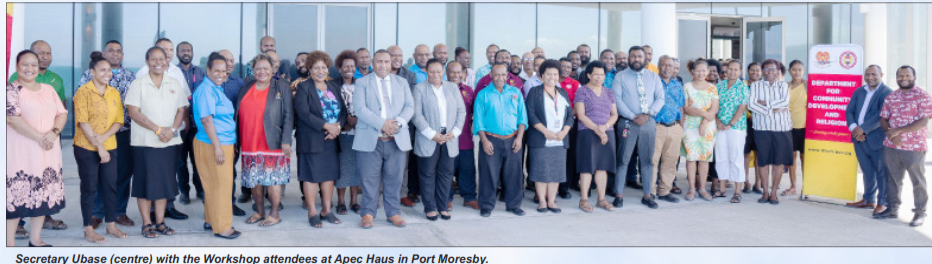
On the same forum held at the Apec Haus in Port Moresby, a CSO participant from Madang, Lazarus Momo recommended that the CIMC become the focal point citizen participation and engagement and which he further proposed could be through the existing CIMC CSO National Coordinating Desk.
“There needs to be more advocacy and trainings on the government system, especial on the bottom up planning process, so citizens are educated on their involvement in the planning process of their ward plans/budgets and that gives them the ideas on various budget allocations from the government, the purposes and the policies align with these budget allocations, that’s when every citizen in PNG will know that, these plans are our plans and they will take ownership of their own plans, this is call Citizen participation of the budgetary process of the government funds because, they start the process at the ward level.
“For effective participation in the district and local government budget process the emphasis should be bottom-up and driven through the CIMC process,” Mr Momo added.
Ends//
----------------------------------------------------------------------------------------------------------------
An AI’s Overview about Social Accountability.
Social accountability is the process where citizens and civil society hold public officials, service providers, and other power holders responsible for their actions, demanding transparency, responsiveness, and effective use of resources, often through civic engagement like public hearings, participatory budgeting, or monitoring, to improve governance and service delivery, especially for vulnerable groups. It moves beyond traditional government accountability by empowering people to claim their rights and ensure commitments are met, focusing on outcomes like better health, education, and equitable development.
Key Aspects of Social Accountability:
Citizen-Led: Relies on ordinary citizens, communities, and organizations to actively demand accountability.
Mechanisms & Tools: Uses various methods, including access to information, client feedback (like scorecards), social audits, participatory budgeting, and public hearings.
Targets Power Holders: Aims to hold governments, public servants, corporations, and even international institutions accountable.
Focuses on Outcomes: Seeks improved public services, reduced corruption, better resource allocation, and empowerment of marginalized groups.
Examples in Practice:
Health Sector: Medical schools commit to addressing community health needs, and citizens use scorecards to monitor local clinic performance.
Governance: Community members participate in budget discussions to ensure funds are used effectively for local projects.
Development: India's social audits for rural employment programs hold local officials accountable for fulfilling entitlements.
Why It Matters:
Improves Services: Leads to better quality and more responsive public services,.
Enhances Governance: Fosters transparency, reduces corruption, and strengthens democratic principles.
Empowers Citizens: Gives a voice to the voiceless and promotes equitable development.
------------------------------------------------------------------------------------------------------------.